
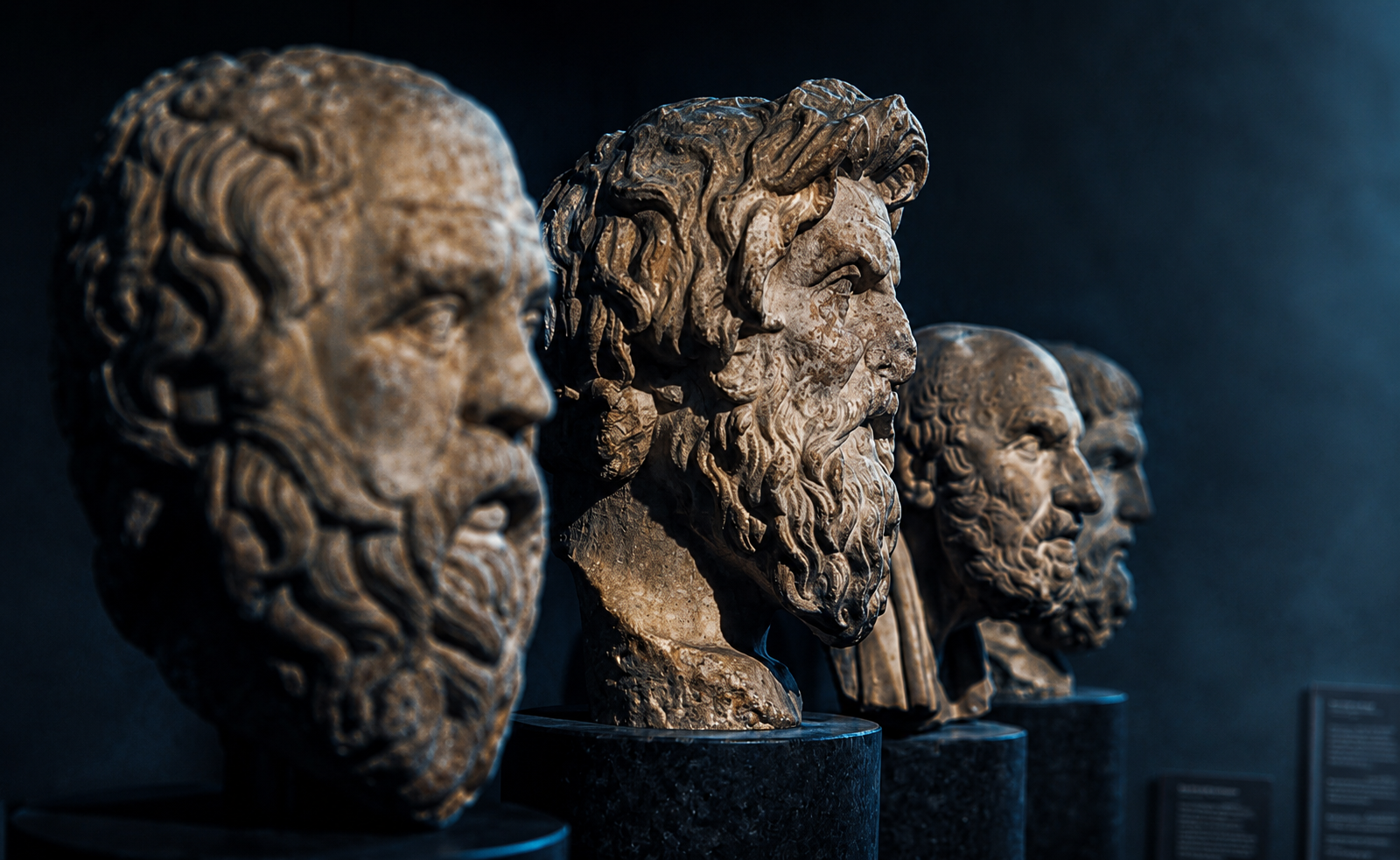
Ancient Greek philosophy is one of the most influential intellectual traditions in human history. It began in ancient Greece around the 6th century BCE and shaped the foundations of Western thought, science, politics, ethics, and logic. Greek philosophers searched for answers about life, reality, knowledge, justice, and the universe through reason and observation rather than myth alone.
The Birth of Philosophy
The earliest Greek philosophers, known as the Pre-Socratics, tried to explain the natural world. Instead of relying entirely on gods and legends, they asked rational questions about existence and the cosmos.
Famous Early Philosophers
- Thales — believed water was the basic substance of the universe.
- Heraclitus — taught that everything constantly changes.
- Pythagoras — connected mathematics with philosophy and harmony.


Socrates: The Father of Western Philosophy
One of the most important philosophers was Socrates. He focused on ethics, morality, and critical thinking. Socrates believed that wisdom begins by recognizing one’s own ignorance.
He developed the Socratic Method, a style of questioning used to examine beliefs and uncover truth. Although Socrates wrote nothing himself, his ideas were recorded by his students.
Key Ideas of Socrates
- Question everything logically.
- Seek truth through discussion.
- Moral knowledge leads to good behavior.
- “Know thyself” became a central philosophical principle.


Plato and the Academy
Plato, a student of Socrates, founded the famous Academy in Athens — one of the first institutions of higher learning in the Western world.
Plato explored topics such as justice, politics, love, and reality. His most famous work, The Republic, described an ideal society ruled by philosopher-kings.
Plato’s Theory of Forms
Plato believed the physical world is imperfect and temporary, while perfect “Forms” or ideals exist beyond it. For example, every beautiful object reflects the perfect Form of Beauty.


Aristotle and Logic
Aristotle was Plato’s student and one of history’s greatest thinkers. He studied biology, politics, ethics, physics, poetry, and logic.
Aristotle emphasized observation and practical reasoning. His work greatly influenced science and philosophy for centuries.
Contributions of Aristotle
- Developed formal logic.
- Classified plants and animals.
- Wrote about ethics and politics.
- Influenced medieval and modern science.


Major Schools of Greek Philosophy
After Socrates, Plato, and Aristotle, several philosophical schools emerged:
Stoicism
Founded by Zeno of Citium, Stoicism taught self-control, discipline, and acceptance of fate.
Epicureanism
Epicurus believed happiness comes from simple pleasures, friendship, and freedom from fear.
Cynicism
Diogenes rejected wealth and social conventions, promoting a simple and natural life.


Influence on the Modern World 🌍
Ancient Greek philosophy still affects modern education, politics, psychology, science, and ethics. Universities teach Greek philosophical ideas worldwide, and concepts developed by Greek thinkers remain central to logic and critical reasoning.
The ideas of Socrates, Plato, and Aristotle continue to inspire debates about truth, justice, happiness, and human nature even after more than two thousand years.
Conclusion
Ancient Greek philosophy marked a turning point in human civilization. By encouraging rational thought and intellectual inquiry, Greek philosophers transformed how people understand the world and themselves. Their legacy remains alive in modern philosophy, science, and democratic thought.