Our Location
304 North Cardinal St.
Dorchester Center, MA 02124

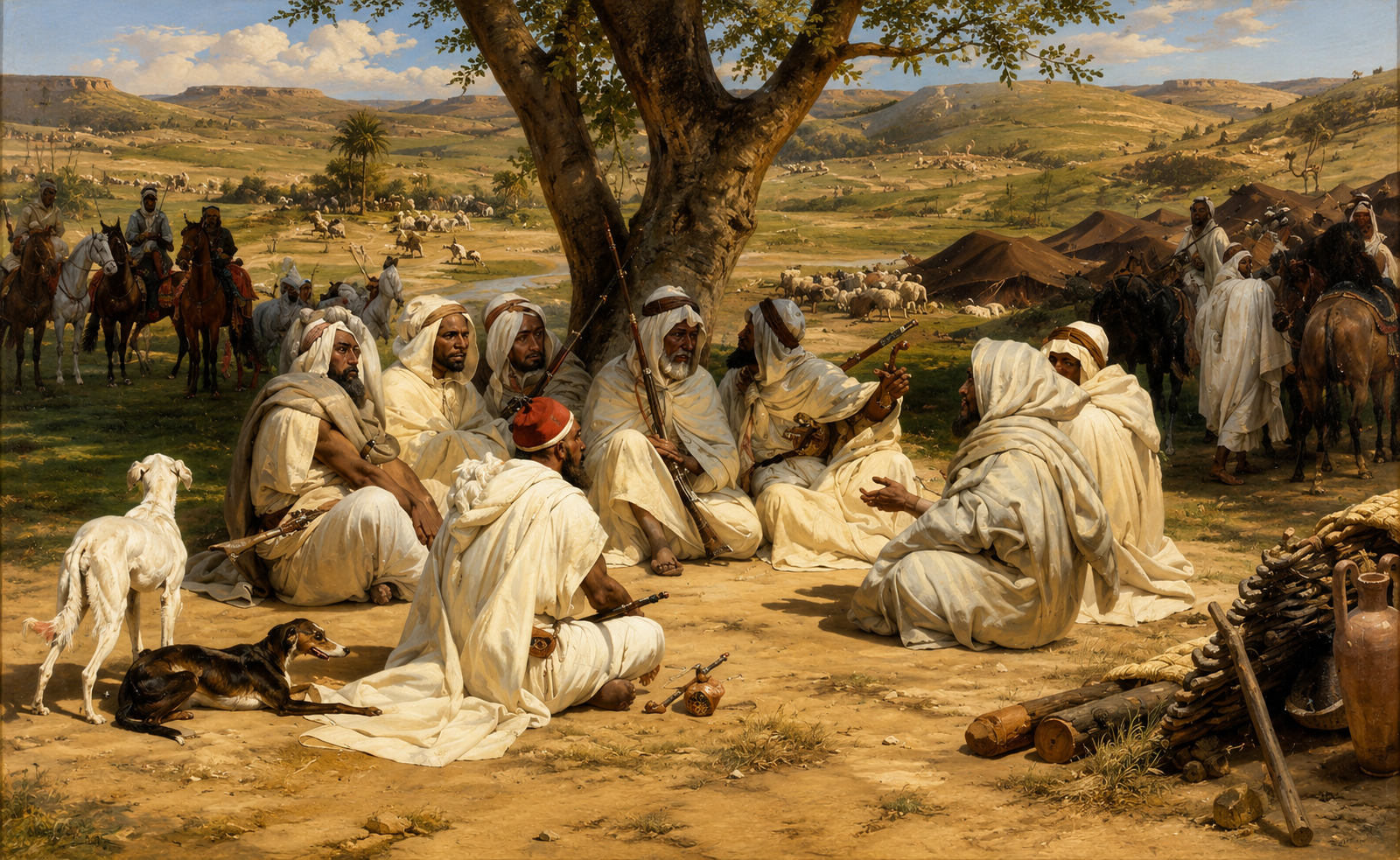
Before Islam gained a hold in the 7th century CE, Arabia was not a unified state but comprised tribes, trading cities and ancient civilizations. This period has collectively become known as Pre-Islamic Arabia or the Age of Jahiliyyah, meaning the ‘Age of Ignorance’. However, despite warring tribal conflicts, Arab society of the time witnessed remarkable feats of poetry, trade and tradition.

Arabia was encircled by a vast desert with mountains to the north and south, and coastal regions to the west. Due to the arid climate of Arabia, many Arabs became nomadic tribes known as Bedouins. These tribes travelled with camels, sheep and goats across the sands of the desert searching for water and pasture. Some important Arab regions:
– Yemen, famed for farming and trade

– Oman and Bahrain, involved in sea trade
The unforgiving environment meant that tribal identity became paramount and was the most fundamental component for individual survival.
Tribal and clan relationships formed the nucleus of Arab society. A tribal leader designated by “Sheikh” presided over all tribes; membership in a tribe was deemed more sacred than virtually anything else. Key Characteristics of Tribal Life:
– Immense loyalty to one’s extended family and tribe.
– Inter-tribal raiding and warring were a frequent feature of life.
– Being honored for bravery and chivalry was valued and respected.
– Poetry was the prominent medium for inter-tribal communication.
– Guests received warm hospitality and courtesy regardless of affiliation.
– Disputes among tribes sometimes resulted in vengeful slaughter of enemies’ descendants lasting several generations.
Before Islam, most Arabs were polytheists who venerated a multitude of gods and idols. In their chief city, Meccah, the Ka’ba contained countless tribal idols and served as an important place of pilgrimage and a holy site for worship of these tribal gods. Famous idols include: Hubal, Al-Lat, Al-Uzza and Manat. However, this was not Universal as there were: Christians, Jews, Zorastians and Hanifs (believers of one God) and also the idols were considered holy sites even before Islam came into existence.
Trade played a fundamental role in the daily lives of Arabs as they facilitated much of the trade connecting Asia, Africa and Europe. As this meant that Arabs became excellent traders, they were dealing with a variety of goods such as: spices, incense, leather, silk, perfumes, gold and silver. Meccah, as stated earlier, flourished thanks to its thriving caravan trade between the Persian and Byzantine Empires.

Poetry was the most celebrated art form of pre-Islamic Arabs. Poets were esteemed for their ability to praise heroism, remember tribal history and ridicule opposition. The finest works were annually rewarded with prizes in Arab markets such asUkaz; these poems were called theMu’allaqator the “Hanging Poems” as they were hung on the doors of the Ka’ba. The core values of Arab culture were: courage, hospitality, loyalty and the power of good speech.
The position of women varied between the many different Arab tribes, but generally in some parts of Arabia woman had considerable sway in the realm of business and other societal matters, while in other regions, woman was often the subject of cruelty. In certain tribes; women were able to gain property, were involved in the caravan trade and other sectors of life, while in other regions, their roles were restricted. The killing of infant girls due to societal constraints in certain areas has been condemned throughout history as abhorrent and in pre-Islamic Arabia these killings were all too common before Islam had been preached and forbidden; however, women did sometimes hold power, which was then subsequently stolen with the arrival of Islamic teachings.
Before Islam there were several ancient kingdoms established within the land of Arabia, which played an integral part in the political and social landscape as Arab society mingled with the outside world in regions such as the:

– Kingdom of Saba located in southern Yemen and its magnificent Marib Dam and wealth.
– Nabataeans was an Arab race that prospered from their mastery of trade at Petra.
– Ghassanids were an Arab Christian kingdom, closely allied with the Byzantine Empire.
– Lakhmids were an Arab kingdom that supported the Persian Empire.
In the 7th century CE, Arabia was a land dominated by social discord, tribal conflicts and a fragmented religious society. It was at this precise time that Muhammad was born and subsequently taught Islamic tenets in Meccah from as early as 610 CE. Islam radically reformed Arab society by: establishing monotheism, abating tribal warfare, reinforcing respect for law and order and furthering education, eventually uniting the majority of the nation in just a few decades.
Arab history before Islam was not void of riches and complexity but instead displayed the ingenuity of the Arab race by presenting a society of rich traditions of poetic excellence, skilled traders and a people that could only survive in the harsh environment they inhabited by the force of sheer tribal unity and loyal co-operation. The development and history of pre-Islamic Arabia also provides an excellent springboard from which we can comprehend how Islam succeeded and indeed prospered in transforming the history of both the Middle East and the rest of the World.
