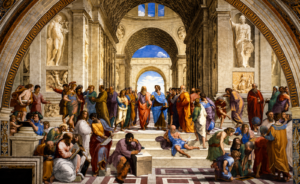
Philosophers Who Rejected God have played a major role in shaping modern thought, science, and secular ethics. Across different eras, these thinkers questioned religious authority, challenged the existence of God, and built alternative explanations based on reason, logic, and human experience.
Rather than simply denying belief, they developed deep philosophical systems that replaced divine explanations with science, ethics, and human freedom.
Below is a structured exploration of the most influential atheist and skeptical philosophers and their most famous arguments. ⚡
1. Friedrich Nietzsche — “God is Dead” ⚰️


🧠 Core Philosophy:
Nietzsche did not argue that “God is logically impossible,” but that belief in God had lost cultural and moral authority in modern society.
🔥 Famous Idea:
“God is dead.”
This does NOT mean God literally died. It means:
- Modern science and reason replaced religious authority
- Traditional moral systems lost foundation
- Humanity must create its own values (“Übermensch” concept)
⚡ Philosophical Impact:
- Collapse of absolute moral truth
- Rise of existentialism and nihilism debates
2. David Hume — Empiricism vs Miracles 🔍


🧠 Core Philosophy:
Hume argued that all knowledge must come from experience and observation—not faith or metaphysics.
🔥 Famous Argument Against Religion:
Critique of Miracles
- Miracles violate natural laws
- Natural laws are supported by consistent experience
- So belief in miracles is always irrational
⚡ Key Idea:
“No testimony is sufficient to establish a miracle unless the falsehood of that testimony would be more miraculous.”
3. Bertrand Russell — Logical Skepticism 🧩


🧠 Core Philosophy:
Russell used logic, language, and probability to challenge religious belief.
🔥 Famous Argument:
Russell’s Teapot
- Imagine a teapot orbiting between Earth and Mars
- You cannot disprove it exists
- But it is irrational to believe in it without evidence
👉 Same applies to God claims:
Burden of proof is on believers.
4. Karl Marx — Religion as Social Tool 🏭


🧠 Core Philosophy:
Marx viewed religion as a product of social and economic conditions.
🔥 Famous Quote:
“Religion is the opium of the people.”
📌 Meaning:
- Religion comforts suffering but does not solve it
- It can maintain social control
- Real change comes through economic transformation
5. Jean-Paul Sartre — Existential Atheism 🧍♂️


🧠 Core Philosophy:
Sartre rejected God as a necessary foundation for meaning.

🔥 Famous Idea:
“Existence precedes essence.”
📌 Meaning:
- Humans are not designed with a purpose
- There is no divine creator defining human nature
- We are fully responsible for creating meaning ourselves
6. Richard Dawkins — Scientific Atheism 🧬


🧠 Core Philosophy:
Dawkins approaches religion through evolutionary biology and science.

🔥 Famous Argument:
- God is a “complex hypothesis”
- Evolution explains complexity without design
- Therefore God is unnecessary as an explanation
📌 Key Idea:
“We are all atheists about most gods humanity has ever believed in.”
⚖️ Summary Comparison
| Philosopher | Main Argument Against Religion |
|---|---|
| Nietzsche | God no longer holds moral authority |
| Hume | Miracles violate empirical reasoning |
| Russell | No evidence → no rational belief |
| Marx | Religion is a social-economic construct |
| Sartre | No divine purpose; meaning is human-made |
| Dawkins | Science explains complexity without God |
Major Themes Across These Philosophers
Despite differences, Philosophers Who Rejected God often share key intellectual patterns:
🔬 1. Empirical Thinking
They rely on observation, evidence, and logic.
🧩 2. Critique of Authority
Religious institutions are questioned as sources of truth.
🧬 3. Human-Centered Meaning
Meaning comes from humans, not divine design.
⚡ 4. Scientific Explanations
Natural laws replace supernatural explanations.
🧩 Final Insight
The legacy of these thinkers is not simply rejection of religion—it is the transformation of how humans understand reality.
They collectively:
- Challenged belief without evidence
- Replaced divine explanations with rational inquiry
- Expanded philosophy into science, politics, and psychology
- Shaped modern secular and atheist thought
Today, their ideas remain central in debates about faith, science, morality, and human existence.