

Introduction
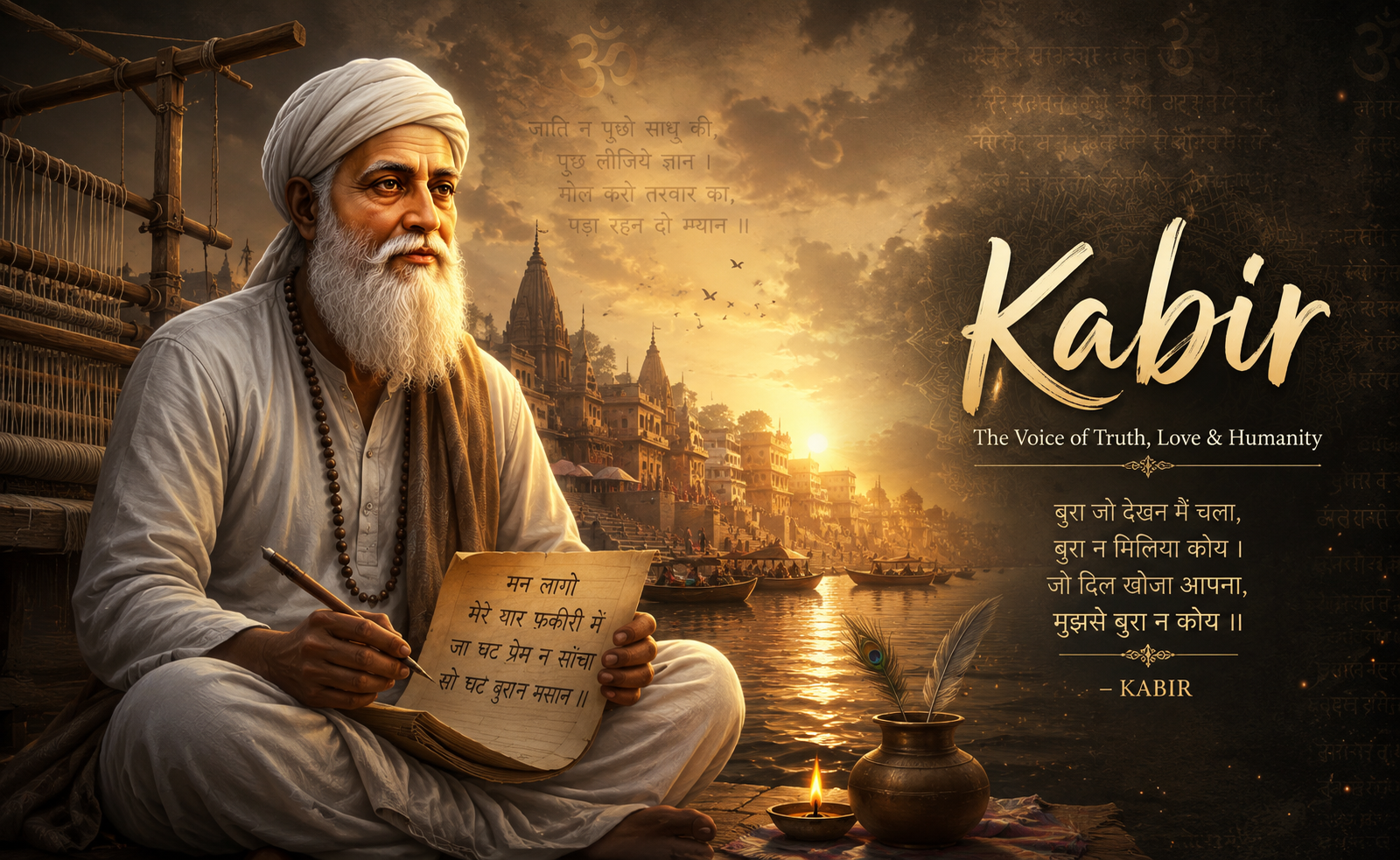
Kabir was one of the greatest mystic poets and spiritual thinkers of India. He is remembered for his powerful poetry, simple wisdom, and messages of love, unity, and truth. Kabir’s teachings challenged religious divisions and encouraged people to look for God within themselves rather than in rituals and external practices.
Even after hundreds of years, Kabir’s poems and ideas continue to inspire millions across the world.
Early Life of Kabir
Kabir was born in the 15th century in India, most likely in the city of Varanasi. According to popular belief, he was raised by a poor Muslim weaver family named Niru and Nima.
Very little is known about his exact birth history, and many stories about his life are legendary. However, Kabir became famous for his spiritual wisdom despite having little formal education.
He worked as a weaver while composing poems and songs that carried deep philosophical meaning.
Kabir and the Bhakti Movement
Kabir was an important figure in the Bhakti Movement, a spiritual movement that focused on devotion and love for God rather than rituals and caste systems.
He criticized both Hindu and Muslim religious leaders for hypocrisy and empty traditions. Kabir believed that all human beings are equal and that God is beyond religion, caste, and social status.
His teachings promoted:
- Humanity and compassion
- Equality among people
- Inner spirituality
- Simplicity in life
- Unity between religions
Kabir’s Poetry


Kabir wrote short poems and couplets known as Dohas. His language was simple and easy to understand, which made his teachings popular among ordinary people.
One of his famous dohas is:
“Kal kare so aaj kar,
Aaj kare so ab.”
This means that people should not delay their work and should act in the present moment.
Another famous teaching of Kabir says:
“Bura jo dekhan main chala,
Bura na milya koi.”
The message is that people should first look at their own faults before criticizing others.
Kabir’s poems are still sung as devotional songs in India today.
Philosophy and Teachings
Kabir believed that God lives inside every person. He rejected blind faith, superstition, and discrimination.
His philosophy can be summarized in three ideas:
1. God is One
Kabir taught that different religions may use different names, but the divine truth is the same.
2. Love is the Path
According to Kabir, love and kindness are more important than rituals and ceremonies.
3. Self-Realization
He encouraged people to search for truth within themselves through meditation and honest living.
Influence on Society


Kabir had a major influence on Indian spirituality and literature. His followers later formed a spiritual community known as the Kabir Panth.
His ideas also influenced many saints and thinkers, including Guru Nanak, the founder of Sikhism.
Several of Kabir’s verses are included in the sacred Sikh scripture, the Guru Granth Sahib.
Legacy of Kabir
Even today, Kabir’s words remain relevant because they speak about peace, humanity, and truth. His poetry teaches people to rise above hatred and religious conflict.
Schools, universities, musicians, and spiritual teachers continue to study and celebrate his work. Kabir’s message reminds humanity that love and wisdom are more powerful than division and intolerance.
Conclusion
Kabir was not just a poet but a revolutionary thinker who challenged social injustice and religious division. Through his simple yet powerful poetry, he taught people the importance of truth, love, and equality.
His timeless teachings continue to inspire people to live with compassion, humility, and inner awareness. Kabir remains one of the brightest spiritual voices in Indian history.