Our Location
304 North Cardinal St.
Dorchester Center, MA 02124

Consciousness still stumps philosophers, psychologists, and neuroscientists. In simple terms, it’s our sense of being alive: noticing ourselves, our thoughts, our feelings, and the world. Any moment you remember a childhood birthday, feel anxious about a big day, or just enjoy the smell of fresh coffee—consciousness is behind it all.

People have wrestled with these questions forever. Ancient thinkers wondered: What makes us aware? Why do we have thoughts? Is our mind something separate from our bodies? Fast forward to now, and scientists and philosophers are still duking it out over the same mysteries.
So, what is consciousness, really? At its heart, it’s being aware. When you listen to music, notice the color red, wince in pain, or daydream about the future—you’re conscious. It feels like this private, inner space where you experience life. Sure, you can try to explain what happiness or heartbreak is like, but no one else can actually feel your mind from the inside.
Types of Consciousness
Experts break consciousness up into a few main categories:
Consciousness in Philosophy
Philosophers can’t help but debate consciousness. René Descartes, for one, made a big impact with his “I think, therefore I am,” arguing the mind and body are two different things. John Locke saw memory as central—our memories shape who we are. And today, questions keep coming: Could a machine actually be conscious? Do animals have an inner life like humans? Why does awareness exist in the first place? No one really knows.

Consciousness and the Brain
Science is trying hard to crack the brain’s role in consciousness. Brain scans show different areas lighting up for different tasks—seeing, hearing, deciding, remembering. But for all the data, nobody really gets how electrified brain cells turn into thoughts and feelings. Philosopher David Chalmers called this the “hard problem of consciousness,” and, honestly, it still bugs everybody.
Animals and Machines
Most scientists agree that many animals are conscious to some degree. Dogs get happy, dolphins recognize themselves in mirrors, and apes outsmart puzzles. But what about insects? Or computers? That’s where it gets really murky. Researchers keep exploring whether there are levels of consciousness stretching across creatures and machines.
Artificial Intelligence enters the conversation more and more. Today’s AI can answer questions and mimic chatting, but most experts say it doesn’t really understand or feel anything. It performs, but there’s nothing “inside.” Who knows, though—technology keeps rewriting the rules.
Spiritual and Religious Views
Religion and spirituality take their own paths. Many faiths link consciousness to the soul or some greater existence. Buddhists talk about consciousness in meditation; Hindus connect it to a universal spirit. Some traditions insist our awareness is more than just a brain process. These ideas might not match up with science, but they keep shaping how people see themselves.
Why It Matters
Figuring out consciousness isn’t just academic. It changes how we think about who we are, free will, right and wrong, even what counts as alive or real. It shapes how we treat animals, how we build technology, how we care for each other. And it pokes at the core questions about life and death.

So, what’s the takeaway? Consciousness is the engine behind everything you feel, think, and know. Science is making progress, but the real nature of conscious experience stays mysterious. Whether you’re drawn to philosophy, brain science, or spiritual ideas, consciousness is always at the center—it’s the question that keeps us curious and, frankly, keeps us human.Does God Exist? One Big Question That Never Goes Away
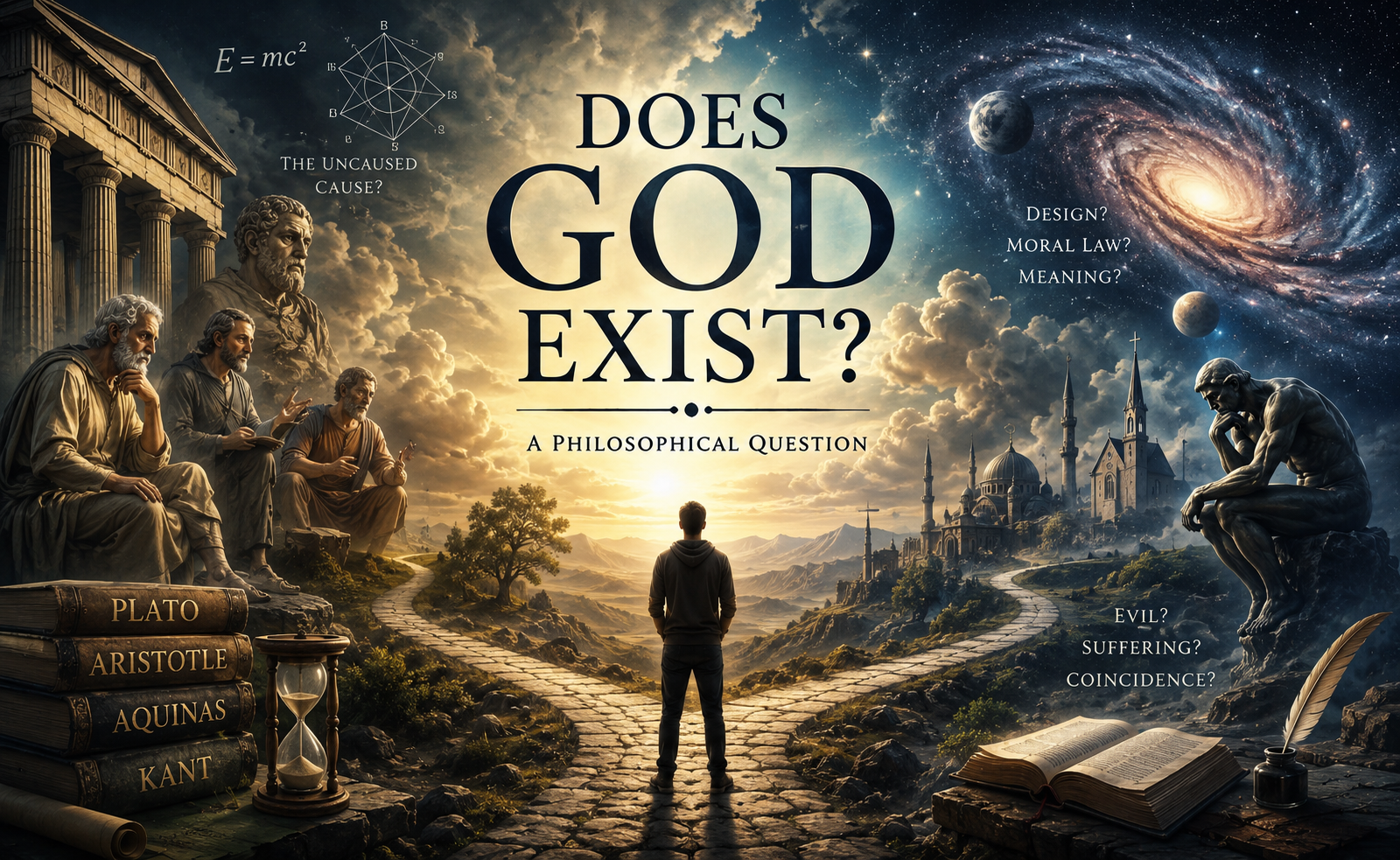
For thousands of years, people have wrestled with a huge question: Is there a God? It’s not just philosophers or scientists — ordinary folks have jumped into the debate, too. Across ancient temples and today’s lecture halls, this question stubbornly shapes our ethics, our science, our cultures, and how we see ourselves.
Some people swear God created everything and gave life meaning. Others say they’ve seen no real evidence for a divine being. Then you’ve got agnostics, who shrug and say, “Maybe it’s impossible to know either way.”
Let’s dig into the big arguments for and against God, and see what philosophy has to say.
So… What Does “God” Even Mean?
Different religions and thinkers paint God very differently. In many branches of philosophy, though, when people talk about God, they usually mean a being who is all-powerful, all-knowing, eternal, created the universe, and is—supposedly—morally perfect.
Religions like Christianity, Islam, and Judaism tend to see God as personal, someone you can pray to, who’s involved in human life.
But some philosophers stretch the idea further. For them, God isn’t a “person” at all, but more like a universal force, consciousness, or just the deepest foundation of all existence.
Arguments for God
Why does anything exist? Why not nothing? Philosophers like Thomas Aquinas believed every effect must have a cause — and if you trace those causes all the way back, you get to the “first cause,” which they call God.
It boils down to:
Everything that starts to exist must have a cause.
The universe started to exist.
So, the universe has a cause.
Some folks link this idea to the Big Bang and the origins of the universe.
Walk outside and really look around — nature, physics, DNA, how everything fits together. For some, all that order and complexity suggests someone (or something) designed it. William Paley once compared it to stumbling upon a watch: you wouldn’t think it just appeared by accident, right?
These days, people connect the design argument to the universe’s “fine-tuning” — the idea that tiny changes in physics would make life impossible.
Why do we think kindness is good and murder is wrong? Philosophers like Immanuel Kant believed that for objective morality to exist — for right and wrong to be “real” and not just opinions — there has to be a higher moral lawgiver. That’s where God comes in, they say. Moral laws exist, so there must be someone who made them.
Arguments Against God
Honestly, this might be the toughest challenge to belief in God. If God is all-powerful and good, why is the world so full of suffering? Look at war, disease, disasters, just everyday pain. Epicurus asked this thousands of years ago, and it still stings.
Critics say a loving, all-powerful God would have stopped pointless suffering. Believers answer in lots of ways — maybe it’s about free will, or maybe suffering builds character or faith.

Some atheists — like Bertrand Russell — say there’s just no solid evidence for God. They argue that big claims need big proof. We used to blame or credit God for lots of things science now explains: evolution, gravity, how the brain works. So, if natural laws explain things pretty well, who needs a God in the picture?
Flip through history or news headlines. Religions disagree on who or what God is, what God wants, or even how many gods there are. When sacred texts and beliefs clash, critics ask: If there’s really one true God, why so much chaos and disagreement?
The Agnostic’s Lane
Not everyone picks Team Faith or Team Atheism. Agnostics say, “I just don’t know if God exists — and maybe no one can.” The philosopher David Hume questioned whether humans can ever truly grasp the nature of reality. Agnostics lean into uncertainty, think critically, and try to keep their minds open.
God in Today’s World
People aren’t done debating God. The question pops up in everything from cosmology to AI to consciousness research. Some scientists sense a deeper intelligence in the patterns of the universe; others say the universe is just following its own rules, no divine hand required.
Even Albert Einstein talked about cosmic mystery and wonder, but his “God” wasn’t the usual old man in the sky.
Why Bother Asking This Question?
This question hangs over everything: how we see right and wrong, what gives life purpose, what happens after death, and what it means to be human. Even people who don’t believe in God grapple with the fallout from this question.
Final Thoughts
No philosopher (or anyone else) has settled this debate once and for all. Philosophy gives us arguments and different ways to think, but no final verdict.
Some find their answer through faith or personal experience; some through skepticism and science. Most are still searching.
Maybe, in the end, what matters most isn’t solving the question, but our stubborn human need to search for meaning in the first place.
